Showing posts with label science tuition maths tuition Physics tuition chemistry tuition. Show all posts

Wednesday, 2 December 2015


Miracle Learning Centre Chemistry Tuition Question on Redox Reactions. (O Level / IP Chemistry)


1 (a) A sample of manganese oxide was analysed and it was found that 11.0 g of manganese had combined with 4.8 g of oxygen. Find the empirical formula of the oxide.

(b) The reaction between manganese (IV) oxide and concentrated hydrochloric acid produces chlorine gas. MnO2 + 4 HCl MnCl2 + Cl2 + 2 H2O

(i) In terms of changes in oxidation states, state and explain which substance is behaving as an oxidising agent in this reaction. ……………………………………………………………………………..………... ……………………………………………………………………………………..
(ii) Explain how aqueous potassium iodide can be used to confirm that manganese (IV) oxide is an oxidising agent. ……………………………………………………………………………..………... ……………………………………………………………………………………..
(iii) 50 cm3 of chlorine gas was produced in the reaction at room temperature and pressure. What was the mass of MnO2 used?

(iv) The chlorine gas produced is bubbled into a solution of sodium bromide. Write an ionic equation for the reaction and describe the observations that will be made. ……………………………………………………………………………..………... ……………………………………………………………………………..………... ……………………………………………………………………………………..
Miracle Learning Centre Answer to Chemistry Tuition Question on Redox Reactions. (O Level / IP Chemistry) 1 (a) Mass (g) No. of moles Simplest ratio Mn 11.0 0.2 1 O 4.8 0.3 1.5 Empirical formula: Mn2O3

(b) (i) MnO2. The oxidation state of Mn decreases from +4 in MnO2 to +2 in MnCl2. Oxidising agents are reduced during reaction.
 (ii) KI is a reducing agent. The presence of an oxidizing agent like MnO2 will oxidize KI, causing it to turn from colourless to brown.
 (iii) No. of moles of Cl2 = (50/1000)/24 = 2.0833 x 10⁻³ No. of moles of MnO2 = 2.0833 x 10⁻³ Mass of MnO2= 2.0833 x 10-3 X (55 + 2 x 16) = 0.181g (to 3 s.f.)
 (iv) Cl2 + 2Br -  Br2 + 2Cl- The colourless solution will turn reddish-brown. Learn from our Chemistry Tuition Questions and Answers. Miracle Learning Centre Call 6463 8756 or sms 8128 8342/9839 9908. (Specialist in Science and Maths) for Primary, Secondary and JC levels. Miracle Learning Centre specialises in Chemistry tuition, Physics tuition, Maths tuition and Science tuition Classes.

Tuesday, 1 December 2015

Miracle Learning Centre Physics Tuition Question on Practical Electricity. (O Level Science Tuition/IP Science Tuition/Secondary Science Tuition)

Fig 11.1 shows a plug fitted with a 13 A fuse.

(i) Explain why a fuse is included the plug. [1] ……………………………………………………………………………..…………………………………………………………………………….. (ii)What is wrong with the way this plug has been wired and how should the mistake be rectified? [2] ……………………………………………………………………………..…………………………………………………………………………….. ……………………………………………………………………………..

Fig 11.2 shows a metal electric kettle which can be used to boil water. The power rating of the kettle is 0.5 kW.

Which part of the kettle should be connected to the earth pin of the plug? [1] ………..…………………………………………………………………………….

Water of mass 0.80 kg, at a temperature of 25°C is to be heated. Calculate the time taken for the water to be heated to a temperature of 90°C. [3] (Take specific heat capacity of water to be 4200 J/kg/°C)

State one assumption that you made in (ii). [1]

The cost of 1 kWh of electrical energy is 25 cents. How much will it cost to operate the heater for 45 minutes. [2]

Miracle Learning Centre Answer to Science Tuition Question on Practical Electricity. (O Level Science Tuition/IP Science Tuition/Secondary Science Tuition) 1 (a)(i) When the current flowing in the live wire is higher than the fuse rating, it will melt and stop current flow and protect the appliance from overheating [A1] (ii) The fuse is connected to the neutral wire [A1]. The fuse should be connected to the live wire. [A1] (b)(i) Metal casing/body of the kettle. [A1] (ii)

(iii) No heat loss to surroundings [A1].
(iv)
Learn from our Science Tuition Questions and Answers. Miracle Learning Centre Call 6463 8756 or sms 8128 8342/9839 9908. (Specialist in Science and Maths) for Primary, Secondary and JC levels. Miracle Learning Centre specialises in Science tuition, Maths tuition, Chemistry tuition and Physics tuition classes.

Miracle Learning Centre Chemistry Tuition Question on Atoms. (O Level Science Tuition /IP Science Tuition /Secondary Science Tuition)

1. The ion of element A contains 12 protons, 12 neutrons 10 electrons. (a) How is an ion formed? (b) Which particles in this ion have (i) a positive charge (ii) no charge (c) What is the nucleon number (mass number) of the ion? (d) Use the Periodic Table to identify element A. (e) What is the number of electrons present in element A? (f) Draw the electronic structure for this ion. (g) A student claimed that element A can exist as molecules. Do you agree? Explain your answer.

2. Use the data in the table to answer the questions that follow.

(a) Which substance is a solid at a temperature of 20°C and a liquid at a temperature of 150°C? ____________________________________________________________

(b)(i) Which substance is a gas at a temperature of –250°C? ____________________________________________________________ (ii) Which of the following diagrams, A – D best represents the structure of a molecule of the substance you have named in (b)(i)? Answer = _____________ (c) How many atoms are there in one ethanol molecule? ____________________________________________________________ (d) State one similarity and one difference between the molecules of hydrogen and hydrogen chloride. ____________________________________________________________ ____________________________________________________________ ____________________________________________________________

Miracle Learning Centre Answer to Science Tuition Question on Atoms. (O Level Science Tuition /IP Science Tuition /Secondary Science Tuition) 1(a) Ion is formed when an atom loses electron or gains electrons (b)(i) Protons (ii) Neutrons (c) 24 (d) Magnesium

2(a) Iodine (b)(i) Hydrogen (ii) B (c) 9 (d) Similarity: both are diatomic molecules / each molecule is made up of 2 atoms chemically combined together. Differences: made up of different atoms of elements. Learn from our Science Tuition Questions and Answers. Miracle Learning Centre Call 6463 8756 or sms 8128 8342/9839 9908. (Specialist in Science and Maths) for Primary, Secondary and JC levels. Miracle Learning Centre specialises in Science tuition, Maths tuition, Chemistry tuition and Physics tuition classes.

Miracle Learning Centre Science Tuition Question on Kinetic Theory. (O Level Science Tuition/IP Science Tuition/Secondary Science Tuition)

1. The diagram shows a car traveling at a constant speed of 30 m/s on a level road. At this speed the car has to overcome a total force of 600 N opposing the car.

a) State the value of the driving force produced by the engine for a constant speed of 30 m/s. _________________________________________________________

b) Explain why the car slows down when it climbs a hill, even though the driving force is unchanged. _________________________________________________________ _________________________________________________________ _________________________________________________________

c) When on the level road and travelling at 30 m/s, the driving force is removed and the car starts to decelerate. If the mass of the car is 800 kg, calculate the deceleration of the car due to the opposing force.

2. A gas in an enclosed container is heated uniformly. Assuming the volume of the container is constant, use the kinetic theory to explain the effect of this heating on the pressure which the gas exerts on the container. _______________________________________________________________ _______________________________________________________________ _______________________________________________________________ _______________________________________________________________ _______________________________________________________________ _______________________________________________________________ _______________________________________________________________ _______________________________________________________________

Miracle Learning Centre Answer to Science Tuition Question on Kinetic Theory. (O Level Science Tuition/IP Science Tuition/Secondary Science Tuition) 1. a) 600 N b) Some of the kinetic energy is converted into gravitational potential energy. c) Deceleration = Retarding Force / mass = 600 / 800 = 0.75 m/s2 2. When the gas in a container is heated, the gas particles gain kinetic energy and move more rapidly. Thus, they hit against the walls of the container with greater force AND greater frequency. As p = F/A, the pressure exerted on the walls of the container rises. Learn from our Science Tuition Questions and Answers. Miracle Learning Centre Call 6463 8756 or sms 8128 8342/9839 9908. (Specialist in Science and Maths) for Primary, Secondary and JC levels. Miracle Learning Centre specialises in Science tuition, Maths tuition, Chemistry tuition and Physics tuition classes.

Miracle Learning Centre Science Tuition Question on Thermal Energy (O Level Science Tuition/IP Science Tuition/Secondary Science Tuition)

1) The figure below shows two identical glass cylinders containing equal volumes of water, initially at room temperature. Identical electric heaters were placed in the cylinders, near the top in cylinder A and near the bottom in cylinder B.

The heaters were switched on at the same time. The readings of the thermometers then changed as shown in the figure below.

a) Explain how heat is spread in a liquid by convection. _________________________________________________________ _________________________________________________________ _________________________________________________________ _________________________________________________________ _________________________________________________________ _________________________________________________________ _________________________________________________________ _________________________________________________________

b) On the figure above, label A or B to indicate the heating curves for the corresponding cylinders. Explain why one cylinder has a slower rate of increase in temperature than the other. _________________________________________________________ _________________________________________________________ _________________________________________________________ _________________________________________________________ _________________________________________________________ _________________________________________________________

2) A baby’s milk bottle containing some milk is heated in a bottle warmer. The bottle warmer has foam filled walls and a shiny outer casing as shown.

The warmer is heated by a 100 W heating element. The heating element raises the temperature of the water in the warmer to 40°C. (a) State the difference between the terms ‘thermal energy’ and ‘temperature’. …………………………………………………………………………………….. …………………………………………………………………………………..

(b) Explain why the rate of thermal energy loss from the bottle warmer can be reduced by (i) the foam filled walls, and ……………………………………………………………………………… (ii) the shiny casing. ………………………………………………………………………………

(c) The warmer contains 0.50 kg of water at a temperature of 25°C. The warmer is set to switch off when the water reaches 40°C. When there is no bottle in the warmer, calculate the time taken to raise the temperature of the water to 40°C. (specific heat capacity of water = 4200 J/(kg°C)) time taken = ……………………..

(d) Give a reason why the water will take a longer time to heat up in reality compared to the answer you obtained in (c). …………………………………………………………………………………….. …………………………………………………………………………………..

Miracle Learning Centre Answer to Science Tuition Question on Thermal Energy. (O Level Science Tuition/IP Science Tuition/Secondary Science Tuition) 1. a) When a liquid is heated, it expands and its density decreases. Hence, it floats up and colder liquid, which is denser, sinks to take its place, thus forming convection currents. b) A has the gentler curve. The temperature of A increases slowly as the heat from the heater can only reach the bottom of the container by conduction. As liquids are poor conductors of heat, the temperature of A increases slowly.

2) A baby’s milk bottle containing some milk is heated in a bottle warmer. The bottle warmer has foam filled walls and a shiny outer casing as shown.

The warmer is heated by a 100 W heating element. The heating element raises the temperature of the water in the warmer to 40°C.

(a) State the difference between the terms ‘thermal energy’ and ‘temperature’. Temperature is a measure of degree of hotness of a body. Thermal energy of a body represents the total kinetic energy of the atoms or molecules in the body.

(b) Explain why the rate of thermal energy loss from the bottle warmer can be reduced by (i) the foam filled walls, and Foam contains trapped air and air is a poor conductor of heat. (ii) the shiny casing. Shiny surfaces are poor emitters of radiant heat.

(c) The warmer contains 0.50 kg of water at a temperature of 25°C. The warmer is set to switch off when the water reaches 40°C. When there is no bottle in the warmer, calculate the time taken to raise the temperature of the water to 40°C. (specific heat capacity of water = 4200 J/(kg°C)) time taken = …………………….. (d) Give a reason why the water will take a longer time to heat up in reality compared to the answer you obtained in (c). There is some heat loss to the surroundings by convection. Learn from our Science Tuition Questions and Answers. Miracle Learning Centre Call 6463 8756 or sms 8128 8342/9839 9908. (Specialist in Science and Maths) for Primary, Secondary and JC levels. Miracle Learning Centre specialises in Science tuition, Maths tuition, Chemistry tuition and Physics tuition classes.

Tuesday, 24 November 2015

Miracle Learning Centre Physics Tuition Question on Electromagnetism. (O Level Science Tuition/IP Science Tuition/Secondary Science Tuition)

Fig. 10.1 shows a metal rod AB placed on two smooth horizontal rails that are fixed in position. The magnetic field is directed perpendicularly into the plane of the paper.

(a) Describe and explain what happens to the rod AB when switch S is closed.

(b) State the effect on the movement of rod AB (if any) when

(i) the current is increased; [1]

(ii) the separation between the rails is decreased. [1]

(c) Suggest one way of reversing the movement of the rod AB. [1]

Miracle Learning Centre Answer to Science Tuition Question on Electromagnetism. (O Level Science Tuition/IP Science Tuition/Secondary Science Tuition) 10 (a) AB will move to the right. [A1] A current carrying wire will experience a force when it is placed in a magnetic field. [A1] (b)(i) It will move faster. [A1] (ii) It will move slower. [A1] (c) Reverse the direction of the current / magnetic field [A1]

Miracle Learning Centre Science Tuition Question (S4 Chem) (O Level Science Tuition/IP Science Tuition/Secondary Science Tuition)

(a) A student was asked to investigate the rate of reaction of magnesium with dilute hydrochloric acid. In the experiment, he used a clean piece of magnesium ribbon 5 cm long with 20.0 cm3 of 0.500 mol/dm3 dilute hydrochloric acid (in excess).

(i) Why is it essential to clean the magnesium ribbon? [1]

(ii) Write a balanced chemical equation for the reaction. [1]

(b) He measured the volume of hydrogen produced at r.t.p. at regular intervals. The results are shown in the graph above.

(i) State the volume of hydrogen gas produced when the reaction is complete. [1]

(ii) Hence, calculate the volume of 0.500 mol/dm3 dilute hydrochloric acid needed to react completely with the 5 cm long ribbon. [2]

(c) Copy the given graph into the writing paper. Then sketch on the same axes, the graphs you would expect if the experiment was repeated, making the following single changes in each case :

(i) Using half the length of cleaned magnesium ribbon. Label this graph A.

(ii) Using a cleaned magnesium ribbon 5 cm long but cut into very small pieces. Label this graph B.

(iii) Using dilute hydrochloric acid of concentration 0.250 mol/dm3. Label this graph C.

(d) Use the particles collision theory to explain your answer to c(iii).

Miracle Learning Centre Answer to Science Tuition Question (S4 Chem) (O Level Science Tuition/IP Science Tuition/Secondary Science Tuition)

B1(a)(i) 2m Cleaning to remove the magnesium oxide layer from the magnesium ribbon. [1]

(ii) The chemical equation is : Mg + 2HCl  MgCl2 + H2 [1]

(b)(i) 3m From the graph, the volume of hydrogen produce is 55cm3. [1]

(ii) Step 1 : Moles of hydrogen = volume/24dm3 = 0.06dm3/24dm3 = 0.0025 moles [1] Step 2 : Moles Ratio 2HCl : H2 2 : 1 y : 0.0025 y = moles of hydrochloric acid = 0.00125 [1] Step 3 : Volume of hydrochloric acid = moles/moles concentration = 0.00125/0.5 mol/dm3 = 0.0025 dm3 [1]

(c)(i), (ii), (iii) 3

(d) 2m - Since the hydrochloric acid concentration is smaller [1], there are fewer hydrogen ions per unit volume of the acid to collide with the magnesium, causing lesser frequency of ‘effective’ collision and decrease the rate of reaction. [1]

Learn from our Science Tuition Questions and Answers. Miracle Learning Centre Call 6463 8756 or sms 8128 8342/9839 9908. (Specialist in Science and Maths) for Primary, Secondary and JC levels. Miracle Learning Centre specialises in Science tuition, Maths tuition, Chemistry tuition and Physics tuition classes.


Miracle Learning Centre Primary Maths Tuition Question on Model Drawing. (PSLE Maths Tuition)


1. School A has as many pupils as School B. School B has as many pupils as School C. If School A has 2234 pupils, how many pupils does School C have?
Miracle Learning Centre Answer to Primary Maths Tuition Question on Model Drawing. (PSLE Maths Tuition)
= 1117 1117 X 5 = 5585 School C has 5585 pupils.
Learn from our Primary Maths Tuition Questions and Answers. Miracle Learning Centre Call 6463 8756 or sms 8128 8342/9839 9908. (Specialist in Science and Maths) for Primary, Secondary and JC levels. Miracle Learning Centre specialises in Maths tuition, Science tuition, Chemistry tuition and Physics tuition classes.

Miracle Learning Centre Primary Maths Tuition Question on Model Drawing. (PSLE Maths Tuition)


1. Faiz, Gary and Subra shared a total of $ 100. Faiz received $ 8 more than Gary. Subra received twice as much as Faiz. How much money did Gary receive ? (Draw a model to help you)
Miracle Learning Centre Answer to Primary Maths Tuition Question on Model Drawing. (PSLE Maths Tuition)
Method 1 4 units ------- $ 100 + $ 8 = $ 108 1 unit ------- $ 108 ÷ 4 = $ 27 27 – 8 = $ 19
Method 2 4 units ------ $ 100 - $ 8 - $8 - $8 = $ 76 1unit ------ $ 76 ÷ 4 = $ 19
Learn from our Primary Maths Tuition Questions and Answers. Miracle Learning Centre Call 6463 8756 or sms 8128 8342/9839 9908. (Specialist in Science and Maths) for Primary, Secondary and JC levels. Miracle Learning Centre specialises in Maths tuition, Science tuition, Chemistry tuition and Physics tuition classes.

Miracle Learning Centre Primary Maths Tuition Question on Fraction. (PSLE Maths Tuition)

1. When litres of water was poured into a container, it was full. What is the capacity of the container?

2. In a school concert, the number of boys is the number of girls. How many more girls than boys are there if there are 630 pupils at the concert?

Miracle Learning Centre Answer to Primary Maths Tuition Question on Fraction. (PSLE Maths Tuition)

1.  l  l  2 = l  l x 3 = 1 litres or 1.3125 litres 2. 9 units  630 1 unit  70 5 units  350

Learn from our Primary Maths Tuition Questions and Answers. Miracle Learning Centre Call 6463 8756 or sms 8128 8342/9839 9908. (Specialist in Science and Maths) for Primary, Secondary and JC levels. Miracle Learning Centre specialises in Maths tuition, Science tuition, Chemistry tuition and Physics tuition classes.

Monday, 23 November 2015

Best Physics Tuition in Singapore

Physics tuition classes in Miracle Learning Centre is very beneficial. If you do not understand physics, you must definitely try the physics tuition class at Miracle Learning Centre.

Albert Einstein Facts

Albert Einstein is perhaps the most famous scientist of all time. Both his image and brilliant work on theoretical physics live on today and he serves as an inspiration to young scientists around the world.

Read on for interesting facts, quotes and information about Albert Einstein.

Albert Einstein was born on the 14th of March 1879 and died on the 18th of April 1955.

Born in Germany to a Jewish family, Einstein made many contributions to the field of theoretical physics.

Even when very young, Einstein showed great ability in both math’s and science. He was naturally curious and had a brilliant analytical mind.

Einstein worked in a patent office evaluating patents for electromagnetic devices not long after he graduated.

He produced perhaps one of the most famous equations ever: E = mc² (energy equals mass multiplied by the speed of light squared).

He is also well known for his theory of relativity. Special relativity being introduced in his 1905 paper “On the Electrodynamics of Moving Bodies” before Einstein developed the theory of general relativity between the years of 1907 and 1915.

Einstein won the 1921 Nobel Prize in Physics for his work on theoretical physics.

He worked on many other influential theories and projects including: the deflection of light by gravity, the quantum theory of atomic motion in solids, Brownian motion, an explanation for capillary action and much more.

Famous Albert Einstein quotes include: "Whether you can observe a thing or not depends on the theory which you use. It is the theory which decides what can be observed."

"If I were not a physicist, I would probably be a musician. I often think in music. I live my daydreams in music. I see my life in terms of music.... I do know that I get most joy in life out of my violin."

"Physical concepts are free creations of the human mind, and are not, however it may seem, uniquely determined by the external world."

"I am enough of an artist to draw freely upon my imagination. Imagination is more important than knowledge. Knowledge is limited. Imagination encircles the world."


Miracle Learning Centre Primary Maths Tuition Question on Algebra. (PSLE Maths Tuition)


1. Box A has 6x beads. Box B has twice as many beads as Box A. How many beads are there in Box B?
2. The charges for making a telephone call on a mobile phone are given in the table below.
(a) How much must Lihui pay if she used the mobile phone for 12 minutes? Express your answer in terms of y. (b) If y=10 and she paid $4.80 for making a call, how long did she use the phone?
Miracle Learning Centre Answer to Primary Maths Tuition Question on Algebra. (PSLE Maths Tuition) 1. 12x 2. (a) 3y + 2y + 10y = 15y cents / $0.15y (b) $4.80 - $0.30 - $0.20 = $4.30 ( 430  10) + 2 = 45 min
Learn from our Primary Maths Tuition Questions and Answers. Miracle Learning Centre Call 6463 8756 or sms 8128 8342/9839 9908. (Specialist in Science and Maths) for Primary, Secondary and JC levels. Miracle Learning Centre specialises in Maths tuition, Science tuition, Chemistry tuition and Physics tuition classes.

Miracle Learning Centre Primary Maths Tuition Question on Algebra. (PSLE Maths Tuition)


1. Find the value of 8p – 5 + 6p – p, if p = 4.
2. A barber charges $h for a haircut. Students are given a 50% discount. How much would he collect from 20 customers, if 7 of them are students?
Miracle Learning Centre Answer to Primary Maths Tuition Question on Algebra. (PSLE Maths Tuition) 1. 47 2. 1student haircut costs $ or $0.5h Total cost = (7 x $ ) + (13 x $h) = $3 + $13h = $16 h or $16.50h
Learn from our Primary Maths Tuition Questions and Answers. Miracle Learning Centre Call 6463 8756 or sms 8128 8342/9839 9908. (Specialist in Science and Maths) for Primary, Secondary and JC levels. Miracle Learning Centre specialises in Maths tuition, Science tuition, Chemistry tuition and Physics tuition classes.

Miracle Learning Centre Physics Tuition Question on Energy. (PSLE Science Tuition)

3. Doris took out a stick of ice-cream from the freezer. She left it on the table when the house phone rang and forgot all about it. After some time, it melted. Which one of the following statements is true about the melting ice-cream?

(1) The ice-cream loses heat and turns to liquid.

(2) The ice-cream gains heat and changes to gas.

(3) The ice-cream loses heat to the surrounding and retains its state.

(4) The ice-cream gains heat from the surrounding and changes its state.

Miracle Learning Centre Answer to Primary Science Tuition Question on Energy. (PSLE Science Tuition) Answer: 4

Learn from our Primary Science Tuition Questions and Answers. Miracle Learning Centre Call 6463 8756 or sms 8128 8342/9839 9908. (Specialist in Science and Maths) for Primary, Secondary and JC levels. Miracle Learning Centre specialises in Science tuition, Maths tuition, Chemistry tuition and Physics tuition classes.

Miracle Learning Centre Science Tuition Question on The Human Eye. (O Level Science Tuition/IP Science Tuition/Secondary Science Tuition)

1(a) A tennis player looks closely at his tennis racquet and ball before he hits his serve. After his serve, he looks at his opponent and adjusts his racquet in anticipation. Describe the changes which take place when the eye focuses on the ball

(i) closely before his serve ,

(ii) from a distance after his serve.

(b) During the lunch interval of a cricket match, the cricketers go indoors for their rest and meal. After the interval, they proceed to the field to resume the match under bright sunlight. Explain how the sudden bright light brings a response in the tissues in the iris. [4]

Miracle Learning Centre Answer to Science Tuition Question on The Human Eye. (O Level Science Tuition/IP Science Tuition/Secondary Science Tuition)

Learn from our Science Tuition Questions and Answers. Miracle Learning Centre Call 6463 8756 or sms 8128 8342/9839 9908. (Specialist in Science and Maths) for Primary, Secondary and JC levels. Miracle Learning Centre specialises in Science tuition, Maths tuition, Chemistry tuition and Physics tuition classes.

Miracle Learning Centre Science Tuition Question on Photosynthesis. (O Level Science Tuition/IP Science Tuition/Secondary Science Tuition)

1(a) Fig 1.1 was set up to show that a certain factor is needed for photosynthesis. The whole set up was placed in the dark for 24 hours and exposed to sunlight for another two hours.

(i) Suggest a reason why the plant was placed in the dark for 24 hours. ………………………………………………………………….……………..... …………………………………………………………………………………..

(ii) 1. State the factor that the set-up in Fig. 1.1 was testing. …………………………………………………………………………………..

2. Give evidence from the set-up to support your answer. ………………………………………………………………….……………..... …………………………………………………………………………………..

(iii) At the end of the experiment, one of the leaves was tested for presence of starch. 1. State the expected result for the starch test. ………………………………………………………………………………….. [1] 2. Explain your answer. ………………………………………………………………….……………..... …………………………………………………………………………………..

(iv) Suggest a control for this experiment. ………………………………………………………………………………….. [1]

(b) Fig. 1.2 shows the plant where its bark around the stem at region X was treated with a jet of super-heated steam.

(i) Predict what would be observed one week later. ………………………………………………………………………………….. [1]

(ii) Give reasons to support your answer. ………………………………………………………………….……………..... ………………………………………………………………….……………..... ………………………………………………………………………………….. [2]

(iii) State a substance that could be found in the fluid extracted from the bark just above region X. ………………………………………………………………………………….. [1]

Miracle Learning Centre Answer to Science Tuition Question on Photosynthesis. (O Level Science Tuition/IP Science Tuition/Secondary Science Tuition)

Learn from our Science Tuition Questions and Answers. Miracle Learning Centre Call 6463 8756 or sms 8128 8342/9839 9908. (Specialist in Science and Maths) for Primary, Secondary and JC levels. Miracle Learning Centre specialises in Science tuition, Maths tuition, Chemistry tuition and Physics tuition classes.

Miracle Learning Centre Science Tuition Question on Human Respiration. (O Level Science Tuition/IP Science Tuition/Secondary Science Tuition)

1(a) What is the main difference between respiration and breathing?

(b) In what ways are the following adapted for gaseous exchange?

(i) leaves of flowering plants and

(ii) the lungs of humans.

(c) The table below gives the approximate percentage volume composition of inhaled and exhaled air in man.

Briefly explain events occurring in the body that brought about the differences.

Miracle Learning Centre Answer to Science Tuition Question on Human Respiration. (O Level Science Tuition/IP Science Tuition/Secondary Science Tuition)

Learn from our Science Tuition Questions and Answers. Miracle Learning Centre Call 6463 8756 or sms 8128 8342/9839 9908. (Specialist in Science and Maths) for Primary, Secondary and JC levels. Miracle Learning Centre specialises in Science tuition, Maths tuition, Chemistry tuition and Physics tuition classes.

Best Science Tuition in Singapore

Miracle Learning Centre Science Tuition Question on Human Reproduction. (O Level Science Tuition/IP Science Tuition/Secondary Science Tuition)

1 Some women have fertility treatment using hormones to help them to have babies. In one type of treatment, eggs are fertilised outside the body, then inserted into the woman’s womb.

Table 3.1 shows the statistics for this type of treatment from a fertility clinic for one year.

Use the data in the table to help you answer the questions below.

(a) What is the relationship between age and the success of fertility treatment? _______________________________________________________________ _______________________________________________________________ ____________________________________________________________[1]

(b) How many of the women aged 38–40 became pregnant as a result of the fertility treatment?

_______________________________________________________________ ____________________________________________________________[1]

(c) (i) Give one advantage of this type of fertility treatment.

_______________________________________________________________ _______________________________________________________________ ____________________________________________________________[1]

(ii) Give one disadvantage of this type of fertility treatment.

_______________________________________________________________ _______________________________________________________________ ____________________________________________________________[1]

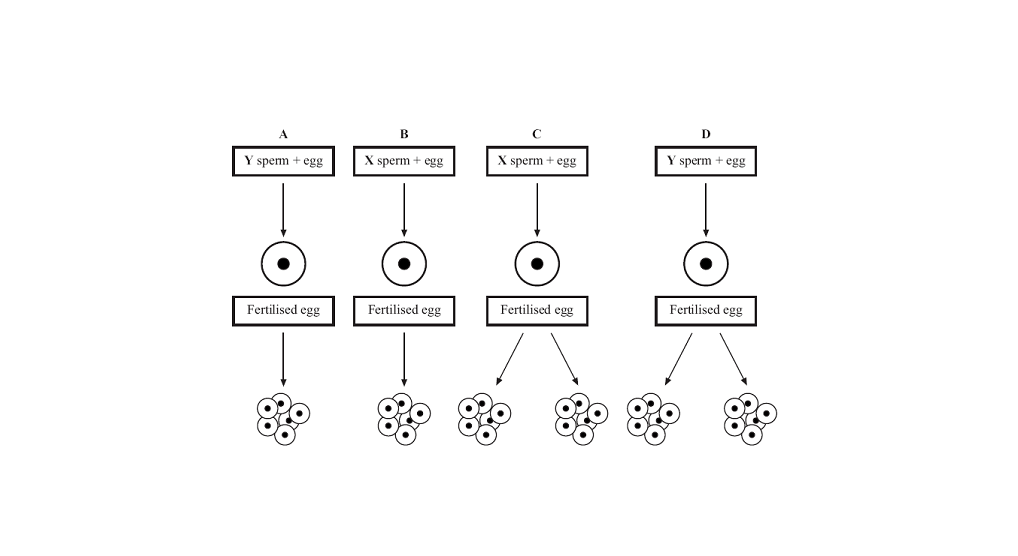
(d) Fig. 3.2 represents four possible types of fertilization and development

Which type of fertilisation and development (A, B, C or D) would produce: (i) one female baby: _______________________________________[1] (ii) identical male twins? ____________________________________[1]

(e) Table 3.3 shows some of the stages in the production of in vitro (test tube) babies.

Suggest two features that the culture medium must have if the production of test tube babies is to be successful.

1 _________________________________________________________ 2 ______________________________________________________[2] [Total:8]

Miracle Learning Centre Answer to Science Tuition Question on Human Reproduction. (O Level Science Tuition/IP Science Tuition/Secondary Science Tuition) 1 Some women have fertility treatment using hormones to help them to have babies. In one type of treatment, eggs are fertilised outside the body, then inserted into the woman’s womb. Table 3.1 shows the statistics for this type of treatment from a fertility clinic for one year.

Use the data in the table to help you answer the questions below.

(a) What is the relationship between age and the success of fertility treatment? • success of fertility treatment decreases with age • success of treatment increases after or at ages 40/41/42 [½m @]

(b) How many of the women aged 38–40 became pregnant as a result of the fertility treatment? 45% of 40 = 45/100 X 40 = 18

(c) (i) Give one advantage of this type of fertility treatment. • helps infertile women increases chance of pregnancy • allows single women to become pregnant • reduced risk of STD • storage of eggs for future use • embryo selection [any 1 ans]

(ii) Give one disadvantage of this type of fertility treatment. • risk of failure/still birth • neutral: • side effects • moral issues e.g. unnatural • expensive • results in multiple births [any 1 ans]

(f) Fig. 3.2 represent four possible types of fertilization and development.

Which type of fertilization and development (A, B, C or D) would produce: (iii) one female baby: B [1] (iv) identical male twins? D [1]

(g) Table 3.3 shows some of the stages in the production of in vitro (test tube) babies.

Suggest two features that the culture medium must have if the production of test tube babies is to be successful. • suitable temperature / body temperature / warm • suitable pH (6-7) • oxygen • nutrients / energy from food • suitable concentrations of / right amount of nutrients • sterile • accept clean if qualified

Learn from our Science Tuition Questions and Answers. Miracle Learning Centre Call 6463 8756 or sms 8128 8342/9839 9908. (Specialist in Science and Maths) for Primary, Secondary and JC levels. Miracle Learning Centre specialises in Science tuition, Maths tuition, Chemistry tuition and Physics tuition classes.

Best Science Tuition in Singapore

Miracle Learning Centre Science Tuition Question on Food Chain/Web. (O Level Science Tuition/IP Science Tuition/Secondary Science Tuition)

1 Over a period of several months, a student recorded some activities of the wild life in a particular habitat. The following observations appeared in her notebook.

(a) Complete Fig. 5.1 by filling in the names of the organisms to show the trophic levels (feeding relationships) in this community.

(b) (i) What name is given to a chart of trophic levels as shown in Fig. 5.1? ______________________________________________________[1] (ii) Name one tertiary consumer. ______________________________________________________[1] (c) Fig. 5.1 also shows how much energy from the bean plants is transferred to each trophic level in the relevant food chain. (i) Where does the energy stored in the bean plants originally come from? ______________________________________________________[1] (ii) Calculate the percentage of energy in A that is transferred to organism B. Show your working. _________________________________________________________ ______________________________________________________[2] (iii) Describe two ways in which energy is lost within a level of a food chain. 1 ___________________________________________________ 2 ________________________________________________[2] (iv) This food chain has four trophic levels. Most food chains have no more than five trophic levels. Explain why the length of food chains is limited in this way. _________________________________________________________ _________________________________________________________ _________________________________________________________ ______________________________________________________[2] [Total: 12]

Miracle Learning Centre Answer to Science Tuition Question on Food Chain/Web. (O Level Science Tuition/IP Science Tuition/Secondary Science Tuition)

(a) Complete Fig. 5.1 by filling in the names of the organisms to show the trophic levels (feeding relationships) in this community.

(b) (i) What name is given to a chart of trophic levels as shown in Fig. 5.1? food web

(ii) Name one tertiary consumer.

hawk / spider

(c) Fig. 5.1 also shows how much energy from the bean plants is transferred to each trophic level in the relevant food chain. (i) Where does the energy stored in the bean plants originally come from? sun / solar energy [1]

(ii) Calculate the percentage of energy in A that is transferred to organism B. Show your working. 130 x 100% = 11.8% 1100

(iii) Describe two ways in which energy is lost within a level of a food chain. 1 lost as heat during respiration / in the faeces as undigested food 2 used for growth / movement / reproduction [2]

(iv) This food chain has four trophic levels. Most food chains have no more than five trophic levels. Explain why the length of food chains is limited in this way. • Because of inefficient energy transformation,a shorter food chain reduces energy losses between trophic levels. • The energy available for the highest trophic level might be too little to sustain the population. [2] Total: 12]

Learn from our Science Tuition Questions and Answers. Miracle Learning Centre Call 6463 8756 or sms 8128 8342/9839 9908. (Specialist in Science and Maths) for Primary, Secondary and JC levels. Miracle Learning Centre specialises in Science tuition, Maths tuition, Chemistry tuition and Physics tuition classes.

Saturday, 21 November 2015

Miracle Learning Centre Primary Science Tuition Question on Energy. (PSLE Science Tuition)

3. Doris took out a stick of ice-cream from the freezer. She left it on the table when the house phone rang and forgot all about it. After some time, it melted. Which one of the following statements is true about the melting ice-cream?

(1) The ice-cream loses heat and turns to liquid. (2) The ice-cream gains heat and changes to gas. (3) The ice-cream loses heat to the surrounding and retains its state. (4) The ice-cream gains heat from the surrounding and changes its state.

Miracle Learning Centre Answer to Primary Science Tuition Question on Energy. (PSLE Science Tuition) Answer: 4

Learn from our Primary Science Tuition Questions and Answers. Miracle Learning Centre Call 6463 8756 or sms 8128 8342/9839 9908. (Specialist in Science and Maths) for Primary, Secondary and JC levels. Miracle Learning Centre specialises in Science tuition, Maths tuition, Chemistry tuition and Physics tuition classes.